Thinking about installing solar panels for your home or business? The total cost of a solar system depends on several factors, including system capacity, panel technology, inverter type, mounting structure, installation requirements and available government incentives.
In this guide, we explain the expected solar installation costs in India in 2026, how system size affects pricing, what equipment is included in a typical solar project, and the factors that can increase or reduce the final project cost. We also look at how to compare solar quotations and choose a system based on long-term performance and value.
What Is the Cost of Solar Panels in India in 2026?
The cost of installing a solar system in India varies depending on the size and type of system you choose. A small residential rooftop system will have a different price from a large commercial or industrial installation.
As a general planning estimate, the total project cost can range from approximately ₹60,000 for a small 1 kW system to several lakhs for larger 10 kW, 20 kW or commercial systems.
The final price depends on:
- Solar system capacity
- Type and efficiency of solar panels
- Solar inverter
- Mounting structure
- DC and AC cables
- Protection equipment
- Installation and labour
- Roof condition and accessibility
- Electrical upgrades
- Net-metering requirements
- Battery storage, if required
- Government subsidy or other applicable incentives
Therefore, it is important to compare the complete installed system cost rather than looking only at the price of solar panels.
Solar System Price in India by Capacity
One of the easiest ways to estimate the investment required is to look at the system capacity.
The following table provides an indicative range for residential rooftop solar systems. Actual prices can vary depending on the equipment selected, installation requirements, location and applicable subsidy.
| Solar System Size | Typical Application | Indicative Price Range* |
|---|---|---|
| 1 kW | Small homes / low electricity consumption | ₹60,000 – ₹90,000 |
| 2 kW | Small households | ₹1.10 lakh – ₹1.50 lakh |
| 3 kW | Medium-sized homes | ₹1.60 lakh – ₹2.10 lakh |
| 5 kW | Large homes / higher consumption | ₹2.50 lakh – ₹3.50 lakh |
| 10 kW | Large homes / small businesses | ₹5 lakh – ₹7 lakh |
*Indicative figures only. Actual project pricing can vary based on panel and inverter brands, system configuration, installation conditions, location, taxes, approvals, subsidy eligibility and other project-specific requirements.
Why Does the Price Increase With System Size?
A larger solar system requires more panels, a larger inverter or multiple inverters, additional mounting structures, more cables and greater installation effort.
However, the cost per kW can sometimes decrease as system size increases because certain project costs, such as site assessment, engineering and other fixed installation expenses, are spread across a larger system.
What Does a Solar Installation Cost Include?
When comparing quotations, it is important to understand exactly what you are paying for.
A complete rooftop solar project generally includes several components.
1. Solar Panels
Solar panels are one of the most visible and important components of a solar power system.
Modern systems commonly use high-efficiency monocrystalline solar panels. The number of panels required depends on the panel wattage and the total system capacity.
For example, a 5 kW system may use fewer high-wattage panels than a system using lower-wattage panels.
When comparing panels, consider:
- Panel efficiency
- Rated power output
- Product warranty
- Performance warranty
- Temperature coefficient
- Manufacturer reputation
- Degradation rate
- Certifications
The cheapest panel is not necessarily the most suitable choice if the system is expected to operate for decades.
2. Solar Inverter
The inverter converts the DC electricity produced by solar panels into AC electricity that can be used by appliances and electrical equipment.
The inverter is another major component affecting the overall solar system price.
Common options include:
- On-grid inverters
- Off-grid inverters
- Hybrid inverters
- String inverters
- Microinverters
The right inverter depends on the type of solar system, electricity consumption, backup requirements and future expansion plans.
3. Mounting Structure
Solar panels need a strong mounting structure to keep them securely positioned on the roof or ground.
The structure should be designed according to:
- Roof type
- Wind conditions
- Panel orientation
- Tilt angle
- Available space
- Structural requirements
For rooftop installations, the mounting system also needs to minimise unnecessary roof penetration and ensure long-term stability.
4. Cables and Electrical Protection
A complete solar installation requires suitable DC and AC cables along with electrical protection equipment.
Depending on the project, this can include:
- DC cables
- AC cables
- DCDB
- ACDB
- Surge protection devices
- Earthing
- Lightning protection
- Isolators
- Connectors
- Distribution equipment
These components play an important role in the safe operation of the solar system.
5. Installation and Labour
Installation costs depend on the complexity of the project.
A simple residential rooftop installation may be relatively straightforward, while a larger installation may require additional engineering, structural work, lifting equipment and electrical modifications.
Factors that can affect installation cost include:
- Roof height
- Roof accessibility
- Roof material
- Distance between panels and inverter
- Cable routing
- Structural modifications
- Electrical panel upgrades
- Site location
6. Net Metering and Approvals
For eligible grid-connected systems, the process may involve electricity distribution company approvals, documentation, inspection and meter-related work.
The exact process and requirements can vary by state and electricity distribution company.
Before installing a rooftop solar system, it is important to understand the applicable requirements in your area.
On-Grid Solar System Cost in India
An on-grid solar system is connected to the electricity grid.
During the day, solar panels generate electricity that can be used directly by the property. Depending on the system and applicable regulations, surplus electricity may be exported to the grid.
One of the main advantages of an on-grid system is that it generally does not require batteries.
This can make the initial investment lower than an equivalent system that includes battery storage.
An on-grid system is commonly suitable for:
- Homes connected to the electricity grid
- Offices
- Shops
- Schools
- Commercial buildings
- Other properties with regular daytime electricity consumption
If your primary objective is to reduce your electricity bill, an on-grid system can be considered where grid connection and applicable regulations permit it.
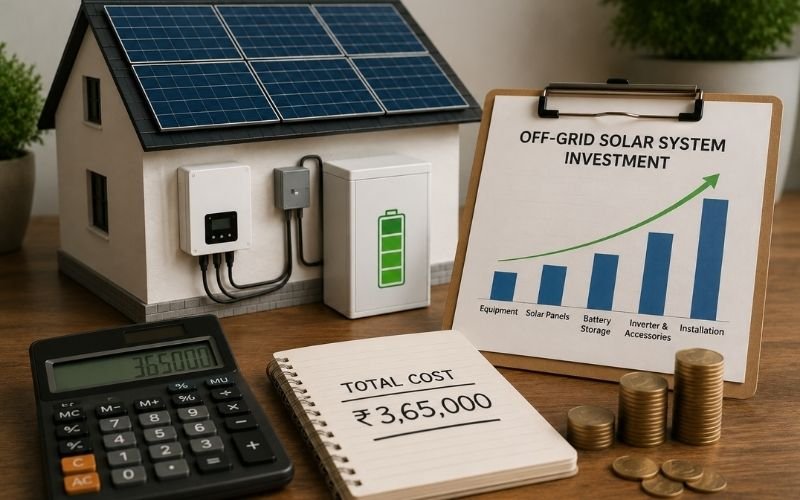
Off-Grid Solar System Cost
An off-grid solar system operates independently of the electricity grid.
Because the system needs to provide electricity even when solar generation is unavailable, batteries are typically an important part of the system.
The total cost therefore depends not only on the solar panels and inverter but also on the required battery capacity.
Off-grid systems can be useful in locations where:
- Grid electricity is unavailable
- Grid supply is unreliable
- A completely independent power system is required
- Remote applications need standalone electricity
The battery bank can significantly increase the initial investment.
Hybrid Solar System Cost
A hybrid solar system combines solar generation, grid connectivity and battery storage.
Depending on the configuration, solar electricity can be used for household or business loads, stored in batteries and supplemented by the grid when necessary.
Hybrid systems are often considered where backup power is important but complete off-grid operation is not required.
The cost depends heavily on the battery capacity and hybrid inverter selected.
What Factors Affect Solar Panel Cost in India?
There is no single solar panel price that applies to every project.
Several factors influence the final quotation.
System Capacity
A 3 kW residential system and a 50 kW commercial system have very different equipment and installation requirements.
Panel Technology
Higher-efficiency panels may have a higher initial cost but can generate more power from a limited roof area.
Inverter Selection
Different inverter technologies and capacities have different prices.
Roof Condition
A simple, accessible roof can be easier to install than a difficult or structurally complicated roof.
Location
Transportation, labour availability and local installation conditions can influence the total project price.
Battery Storage
Adding batteries can substantially increase the upfront investment.
Electrical Modifications
Some buildings may require electrical upgrades before the solar system can be installed.
System Design
A properly designed system considers roof space, shading, orientation, electricity consumption and expected generation.
Solar Panel Cost vs Solar System Cost
It is important to distinguish between solar panel price and complete solar system price.
For example, if someone quotes only the price of solar panels, that amount may not include:
- Inverter
- Mounting structure
- Cables
- Protection devices
- Installation
- Transportation
- Electrical work
- Approvals
- Monitoring equipment
The complete installed project cost is therefore more useful when calculating your actual investment.
When requesting quotations, ask the installer for a detailed bill of materials and scope of work.
How Much Does a 1 kW Solar System Cost?
A 1 kW solar system is generally suitable for properties with relatively low electricity consumption.
The exact electricity generation depends on factors such as:
- Location
- Solar irradiation
- Panel orientation
- Tilt angle
- Shading
- System efficiency
- Weather conditions
A 1 kW system may be appropriate for a small electricity requirement, but homeowners should assess their actual electricity consumption before selecting the system size.
How Much Does a 3 kW Solar System Cost?
A 3 kW system is commonly considered for residential properties with moderate electricity consumption.
It can be suitable for households using appliances such as:
- Fans
- Lights
- Refrigerators
- Televisions
- Washing machines
- Computers
- Water pumps
- Other household appliances
The appropriate capacity should be calculated based on electricity consumption rather than simply choosing a standard system size.
How Much Does a 5 kW Solar System Cost?
A 5 kW solar system can be suitable for larger homes with higher electricity consumption.
Homes with multiple air conditioners, refrigerators, water heaters, pumps and other high-consumption appliances may require a larger system.
Before installation, a solar professional should evaluate:
- Historical electricity bills
- Monthly electricity consumption
- Daytime electricity usage
- Available roof area
- Roof orientation
- Shading
- Future electricity requirements
How Much Does a 10 kW Solar System Cost?
A 10 kW system can be suitable for large residential properties, offices, shops and small commercial buildings.
A system of this size requires more roof area and may require a more detailed electrical and structural assessment.
For commercial installations, system design should also consider the property's load profile and when electricity is consumed during the day.
Government Subsidy and Solar Incentives
Government incentives can have a significant impact on the effective cost of a residential rooftop solar installation.
For eligible residential consumers, the PM Surya Ghar: Muft Bijli Yojana provides central financial assistance for qualifying rooftop solar installations, subject to the applicable scheme rules.
The amount of financial assistance depends on the system capacity and the prevailing government guidelines.
Because subsidy rules, eligibility criteria and implementation procedures can change, homeowners should verify the latest information through official government sources before making an investment decision.
It is also important to distinguish between the gross system price and the effective cost after applicable subsidy.
How to Calculate the Return on Investment of Solar
Solar should be viewed as a long-term energy investment rather than simply an equipment purchase.
A simple payback calculation can be expressed as:
Payback Period = Net Solar Investment ÷ Annual Electricity Savings
For example, if:
- Net system investment = ₹3,00,000
- Estimated annual electricity savings = ₹60,000
Then:
Estimated payback = ₹3,00,000 ÷ ₹60,000 = 5 years
This is only a simplified calculation.
Actual savings can vary depending on electricity tariffs, solar generation, system performance, consumption patterns, maintenance and other factors.
What Is the Expected Life of a Solar System?
Solar panels are designed for long-term operation.
The panels themselves can continue generating electricity for many years, although their output gradually decreases over time.
When evaluating a solar system, look at:
- Product warranty
- Performance warranty
- Inverter warranty
- Installation warranty
- Expected degradation
- Availability of service and replacement parts
A slightly higher initial investment in reliable equipment and professional installation can be relevant when comparing systems intended to operate for decades.
How to Compare Solar Quotations
Getting multiple quotations is useful, but comparing only the final price can be misleading.
Instead, compare the complete specifications.
Check the Solar Panels
Ask for:
- Brand
- Model
- Wattage
- Efficiency
- Product warranty
- Performance warranty
Check the Inverter
Ask for:
- Brand
- Model
- Capacity
- Warranty
- Monitoring features
- Number of MPPTs
Check the Mounting Structure
Ask about:
- Material
- Corrosion protection
- Design
- Warranty
- Structural specifications
Check Electrical Components
Confirm whether the quotation includes:
- DCDB
- ACDB
- Earthing
- Lightning protection
- Surge protection
- Cables
- Connectors
Check Installation
Make sure the quotation clearly states whether it includes:
- Transportation
- Installation
- Commissioning
- Documentation
- Net-metering support
- Testing
How Much Roof Space Is Required for Solar Panels?
The required roof area depends on the system capacity and the wattage and dimensions of the selected panels.
Higher-efficiency panels can generate more electricity from a smaller area.
However, the actual usable roof area also needs to account for:
- Panel spacing
- Walkways
- Shadows
- Roof obstacles
- Water tanks
- Parapet walls
- Maintenance access
A professional site survey can provide a more accurate assessment.
Does Solar Panel Orientation Affect Cost and Performance?
Yes.
Solar panels should be installed in an orientation and tilt suitable for the location and site conditions.
Poor orientation or shading can reduce energy generation.
Before installation, the site should be evaluated for potential shading from:
- Buildings
- Trees
- Water tanks
- Chimneys
- Nearby structures
Even partial shading can affect system performance depending on the panel and inverter configuration.
Is a More Expensive Solar System Better?
Not necessarily.
The objective should be to find a system that provides an appropriate balance between:
Initial Cost + Energy Generation + Reliability + Warranty + Long-Term Performance
A very low quotation may exclude important components or use lower-cost equipment.
At the same time, the most expensive quotation is not automatically the best choice.
This is why homeowners and businesses should compare the equipment specifications, warranties, installation scope and expected generation rather than comparing only the total price.
Ways to Reduce Solar Installation Costs
There are several ways to manage the initial investment.
Choose the Right System Size
Avoid significantly oversizing or undersizing the system.
The system should be based on actual and expected electricity consumption.
Compare Multiple Quotations
Obtain detailed quotations from multiple installers and compare the specifications.
Check Available Subsidies
If you are eligible for a government subsidy or incentive, understand the current rules before finalising the project.
Use Available Roof Space Efficiently
A well-designed system can make better use of the available roof area.
Consider Long-Term Value
Look beyond the initial price and consider equipment warranties, expected generation, maintenance and service support.
Solar Panel Cost in Kerala
Solar installation prices in Kerala can vary depending on system size, equipment selection, roof type, installation location and other project requirements.
Kerala has significant potential for rooftop solar, but properties should still be assessed individually.
Important considerations include:
- Roof orientation
- Available roof area
- Shading
- Rainfall and weather conditions
- Roof construction
- Electrical connection
- Electricity consumption
- Local DISCOM requirements
For a property in Kerala, a site-specific assessment is preferable to relying only on a generic per-kW price.
Solar Panel Cost for Homes vs Businesses
The economics of solar can differ significantly between residential and commercial properties.
Residential Solar
Residential systems are generally designed around household electricity consumption.
Important considerations include:
- Monthly electricity bills
- Available roof space
- Subsidy eligibility
- Daytime vs evening consumption
- Backup requirements
Commercial Solar
Businesses may have higher electricity consumption and substantial daytime loads.
Commercial projects may therefore require:
- Larger system capacity
- Detailed load analysis
- Structural assessment
- Larger inverters
- More extensive electrical infrastructure
- Commercial-scale monitoring
For businesses, the potential savings should be evaluated against the total project investment and expected operating period.
Why Solar System Quality Matters
A solar system is a long-term investment.
Panels may operate for decades, while the inverter and other components may require replacement during the system's lifetime.
Choosing equipment based only on the lowest initial price can make it difficult to assess the system's long-term value.
A reliable solar installation should have:
- Quality components
- Correct system sizing
- Proper installation
- Appropriate electrical protection
- Good ventilation
- Suitable mounting
- Professional commissioning
- Monitoring and maintenance support
Common Mistakes to Avoid When Buying Solar
Choosing a System Only Based on Price
The cheapest quotation may not include the same equipment or services as another quotation.
Ignoring the Inverter
The inverter is a critical part of the system and should not be treated as an afterthought.
Not Checking Warranty Details
Always understand what is covered by product and performance warranties.
Installing Without a Site Assessment
Roof conditions and shading can significantly affect the final design.
Not Checking Future Electricity Needs
If your electricity consumption is expected to increase, consider this during system planning.
Comparing Only Panel Prices
The total installed system cost is more important than the panel price alone.
Is Solar Worth the Investment in 2026?
The answer depends on your electricity consumption, system cost, available sunlight, applicable incentives, electricity tariff and expected system performance.
For properties with suitable roof space and significant electricity consumption, solar can reduce reliance on grid electricity and lower electricity expenses over the system's operating life.
The most useful way to evaluate a solar project is to compare:
Total Investment → Expected Generation → Electricity Savings → Payback Period → Long-Term Benefits
Rather than focusing only on the initial price, consider the complete financial and technical picture.
Frequently Asked Questions
What is the solar panel cost in India in 2026?
The cost varies according to system capacity, panel and inverter selection, installation requirements, roof conditions and applicable incentives. Small residential systems can start from tens of thousands of rupees, while larger residential and commercial installations can cost several lakhs.
How much does a 3 kW solar system cost in India?
An indicative installed cost for a 3 kW residential system may be around ₹1.6 lakh to ₹2.1 lakh before considering applicable subsidies or incentives. Actual quotations vary by equipment, location and installation requirements.
How much does a 5 kW solar system cost?
A 5 kW residential system may typically cost around ₹2.5 lakh to ₹3.5 lakh before applicable subsidies, depending on the components and project requirements.
Is solar cheaper after subsidy?
For eligible installations, government financial assistance can reduce the effective upfront cost. The actual benefit depends on the applicable scheme, eligibility and current government guidelines.
What is the difference between on-grid and off-grid solar?
An on-grid system is connected to the electricity grid, while an off-grid system operates independently and generally requires battery storage.
Does a solar system need batteries?
Not necessarily. On-grid systems generally operate without batteries. Batteries are typically used when backup power or off-grid operation is required.
How long do solar panels last?
Solar panels are designed for long-term operation and generally continue producing electricity for many years, although their output gradually decreases over time. Always check the manufacturer's specific product and performance warranties.
How much roof space is needed for solar?
The required area depends on the system capacity, panel wattage, panel dimensions and roof layout. A site assessment provides the most accurate estimate.
Can solar completely eliminate my electricity bill?
Not necessarily. The result depends on your electricity consumption, system size, generation, tariff structure, grid connection and applicable net-metering or billing arrangements.
Should I install solar based only on the price per kW?
No. Compare the complete system specification, including panels, inverter, mounting structure, protection equipment, installation, warranties, expected generation and after-sales service.
Final Thoughts: Understanding Solar Panel Cost in India 2026
The solar panel cost in India in 2026 depends on much more than the price of the panels themselves.
The final investment is influenced by system capacity, panel technology, inverter, mounting structure, installation conditions, electrical requirements, battery storage and applicable government incentives.
For homeowners and businesses, the best starting point is to understand your electricity consumption and available roof area. From there, a properly designed solar system can provide a clearer picture of the required investment, expected generation and potential savings.
Before choosing an installer, compare detailed quotations rather than simply selecting the lowest price. Check the equipment brands and specifications, warranties, installation scope, protection systems, expected generation and after-sales support.
If you are considering solar for your home or business, Nexren Energy can help you evaluate your requirements and identify a suitable solar solution based on your electricity consumption, property and energy goals.
Ready to explore solar for your property? Get in touch with Nexren Energy for a solar assessment and project quotation.