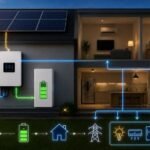
Solar battery storage allows you to store excess electricity generated by your solar panels during the day and use that stored energy when solar generation is low or unavailable.
Batteries can be particularly useful for hybrid and off-grid solar systems, where backup power, energy independence, and better use of solar generation are important considerations.
However, choosing the right battery capacity is not simply a matter of selecting the largest battery available.
Battery sizing should be based on your electricity consumption, the appliances you want to operate, required backup duration, battery chemistry, depth of discharge, system efficiency, solar generation, and your overall energy requirements.
This guide explains how solar battery storage works, how battery capacity is measured, how much battery storage you may need, and the factors to consider before choosing a battery for your solar system.
What Is Solar Battery Storage?
A solar battery is an energy storage device that stores electricity generated by your solar panels so it can be used later.
During sunny periods, your solar panels generate electricity. If your property is not using all of the electricity being produced, the excess energy can be directed to the battery, depending on the system configuration.
The stored energy can then be used when:
- Solar generation is low
- The sun has set
- Electricity consumption increases
- A grid outage occurs
- The system is operating independently from the grid
Battery storage can therefore help shift the use of solar energy from the time it is generated to a later period.
Why Do You Need a Solar Battery?
Not every solar installation requires a battery.
A typical grid-connected solar system can operate without battery storage. Electricity generated by the panels can be consumed directly, while electricity can be imported from the grid when solar generation is insufficient.
A battery becomes more relevant when you want to:
- Store excess solar energy
- Use more solar power after sunset
- Have backup electricity during grid outages
- Reduce dependence on grid electricity
- Operate an off-grid solar system
- Improve energy availability during periods of low solar generation
The importance of battery storage depends on how your property consumes electricity.
How Does a Solar Battery Work?
A typical solar-plus-battery system works through several stages.
During the Day
Solar panels generate electricity.
The electricity can first be used by appliances operating in the property.
If more electricity is generated than the property is consuming, the excess can be used to charge the battery, depending on the system configuration.
During the Evening
When solar generation decreases or stops, the battery can supply stored electricity to the property's selected loads.
This allows some of the electricity generated during the day to be used later.
During a Power Outage
In a properly configured backup system, the battery can supply electricity to selected circuits during a grid outage.
The amount of equipment that can operate depends on:
- Battery capacity
- Inverter capacity
- Maximum discharge power
- Connected loads
- Backup configuration
- State of charge
A battery does not automatically mean that every appliance in a home will operate during a power cut.
What Does Battery Capacity Mean?
Battery capacity is generally expressed in kilowatt-hours (kWh).
For example:
- 5 kWh battery = approximately 5 kWh of nominal stored energy
- 10 kWh battery = approximately 10 kWh of nominal stored energy
- 15 kWh battery = approximately 15 kWh of nominal stored energy
However, the entire nominal capacity may not always be available for everyday use.
Battery sizing needs to consider factors such as:
- Depth of discharge
- Battery efficiency
- Inverter efficiency
- System losses
- Minimum reserve requirements
Therefore, a 10 kWh battery does not necessarily mean that 10 kWh will be available to your appliances.
What Is Depth of Discharge?
Depth of discharge (DoD) describes how much of a battery's stored energy can be used before it needs to be recharged.
For example, if a battery has a nominal capacity of 10 kWh and the usable DoD is 90%, approximately 9 kWh may be available before reaching the specified discharge limit, before accounting for other system losses.
A battery should be selected according to the manufacturer's specifications rather than assuming that the entire nameplate capacity is always usable.
How Much Battery Capacity Do You Need?
The amount of battery storage required depends primarily on how much electricity you want the battery to supply and for how long.
A simple starting point is:
Required battery capacity ≈ Energy required during backup ÷ usable battery fraction
For a more practical estimate, system efficiency and reserve requirements should also be considered.
For example, suppose your selected backup loads consume approximately 5 kWh during the required backup period.
If you plan to use a battery with a usable fraction of 90%, the nominal battery capacity would need to be greater than 5 kWh.
Additional system losses and reserve requirements should then be considered when selecting the final battery size.
This is why battery sizing should be based on actual load calculations rather than simply choosing a battery based on your monthly electricity bill.
Calculate Your Backup Load
The first step in sizing a battery is identifying which appliances you actually need to operate during a power outage.
For example, your essential backup loads may include:
- Lights
- Fans
- Wi-Fi router
- Television
- Refrigerator
- Computer
- Security cameras
- Small appliances
You may decide not to include high-power appliances such as:
- Air conditioners
- Electric water heaters
- Large pumps
- Electric ovens
- High-power cooking equipment
unless the battery and inverter are specifically designed to support them.
Reducing the number of backup loads can significantly reduce the required battery capacity.
Example: Estimating Backup Battery Requirements
Consider a home with the following essential loads:
| Appliance | Approximate Power | Usage | Estimated Energy |
|---|---|---|---|
| 4 LED lights | 40 W | 5 hours | 0.20 kWh |
| 3 fans | 210 W | 6 hours | 1.26 kWh |
| Wi-Fi router | 15 W | 8 hours | 0.12 kWh |
| Refrigerator | 150 W average* | 8 hours | 1.20 kWh |
| Television | 100 W | 4 hours | 0.40 kWh |
| Laptop | 60 W | 4 hours | 0.24 kWh |
| Estimated total | 3.42 kWh |
*Actual refrigerator consumption varies because the compressor cycles on and off.
In this example, the essential loads require approximately 3.42 kWh during the specified period.
The final battery size would need to account for battery DoD, inverter efficiency, system losses, reserve requirements, and actual appliance consumption.
This means a battery somewhat larger than the calculated energy requirement may be appropriate.
Battery Capacity vs Inverter Capacity
Battery capacity and inverter capacity are not the same thing.
Battery Capacity
Measured primarily in kWh, battery capacity determines how much energy can be stored and supplied over time.
Inverter Capacity
Measured primarily in kW or kVA, inverter capacity determines how much electrical power the system can deliver at a particular time.
For example, a battery may have sufficient stored energy to operate your home for several hours, but an inverter that is too small may not be able to start or operate multiple high-power appliances simultaneously.
Therefore, both battery capacity and inverter capacity need to be considered.
Why Peak Power Matters
Some appliances require considerably more power when starting than they consume during normal operation.
Motors and compressors can have higher startup requirements.
Examples include:
- Refrigerators
- Water pumps
- Air conditioners
- Certain power tools
If these appliances need to operate during a power outage, the inverter must be capable of handling their starting requirements.
A large battery alone cannot compensate for an inverter that is not designed for the required power demand.
Lithium-Ion vs Other Battery Technologies
Battery chemistry is another important consideration.
Modern solar energy storage systems commonly use lithium-based batteries, including lithium iron phosphate (LiFePO₄) technology.
Different battery technologies can vary in:
- Usable capacity
- Cycle life
- Efficiency
- Maintenance requirements
- Weight
- Installation requirements
- Cost
- Safety characteristics
When comparing batteries, do not look only at the advertised capacity.
Also compare the manufacturer's specifications, warranty, usable capacity, expected cycle life, operating conditions, and compatibility with your inverter.
What Is LiFePO₄?
Lithium iron phosphate (LiFePO₄ or LFP) is a lithium-ion battery chemistry widely used in stationary energy storage applications.
LFP batteries are known for characteristics such as good cycle performance and thermal stability compared with some other lithium-ion chemistries.
However, the performance of an individual battery depends on its design, cells, battery management system, operating conditions, and manufacturer specifications.
How Many Hours Can a Solar Battery Provide Backup?
Backup duration depends on the battery's usable energy and the electrical load being supplied.
A simplified calculation is:
Backup time ≈ usable battery energy ÷ average load
For example, if a battery provides 9 kWh of usable energy and the connected loads consume an average of 1 kW:
Backup time ≈ 9 hours
If the average load increases to 2 kW:
Backup time ≈ 4.5 hours
Actual backup duration can be different because of inverter losses, battery efficiency, changing appliance loads, battery reserve settings, and other system factors.
Do You Need a Battery for an On-Grid Solar System?
Not necessarily.
Many on-grid solar systems operate without batteries.
If your primary objective is reducing electricity bills and you have reliable grid electricity, an on-grid system may be able to meet your requirements without energy storage.
A battery becomes more relevant when you want:
- Backup power
- Greater evening use of stored solar energy
- Reduced grid dependence
- Energy storage for an appropriate tariff or operating strategy
Do You Need a Battery for an Off-Grid Solar System?
Generally, yes.
An off-grid solar system does not have the electricity grid available as a backup source.
Battery storage is therefore an important part of maintaining electricity availability when solar panels are not generating enough power.
The battery system must be appropriately sized for:
- Daily energy consumption
- Night-time loads
- Peak loads
- Backup requirements
- Periods of low solar generation
Off-grid systems may also require additional solar generation or battery capacity to account for periods when solar production is reduced.
Do Hybrid Solar Systems Need Batteries?
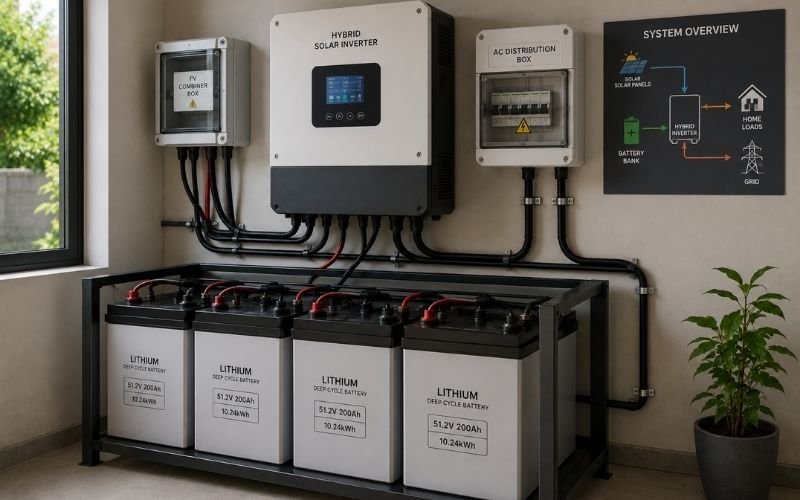
Hybrid solar systems commonly use batteries because battery storage is one of the main features that differentiates a hybrid system from a basic grid-connected solar system.
A hybrid system can combine:
- Solar generation
- Battery storage
- Grid electricity
- Backup power
The battery can store excess solar energy and supply selected loads when solar generation is unavailable or when the grid is down, depending on the system configuration.
Should You Buy the Largest Battery Available?
Not necessarily.
A larger battery provides more stored energy, but it also increases system cost.
An oversized battery may not provide enough additional value if your actual electricity requirements are relatively low.
The goal should be to select a battery that provides an appropriate balance between:
- Required backup duration
- Daily energy usage
- Solar generation
- Battery capacity
- Inverter capacity
- Budget
- Future electricity requirements
A professional load assessment can help determine the appropriate capacity.
Factors That Affect Solar Battery Sizing
Several factors should be considered before selecting a battery.
1. Daily Electricity Consumption
Your electricity bills can provide a starting point for understanding overall consumption.
However, monthly consumption alone does not determine the required battery size.
2. Backup Loads
Identify which appliances must operate during a power outage.
3. Backup Duration
Decide whether you need:
- A few hours of backup
- Overnight backup
- Longer backup during extended outages
4. Depth of Discharge
Check the manufacturer's recommended usable depth of discharge.
5. Battery Efficiency
Energy is lost during charging and discharging, so efficiency should be included in the calculation.
6. Inverter Efficiency
The inverter also consumes some energy during operation.
7. Peak Loads
Consider the maximum simultaneous power demand.
8. Future Electricity Usage
If you plan to add appliances or an electric vehicle, your future energy requirements should be considered.
9. Solar Generation
The solar array should be capable of producing enough energy to recharge the battery according to your usage pattern and local conditions.
10. Weather and Seasonal Changes
Solar generation can vary depending on weather, season, shading, and system orientation.
This is particularly important for off-grid systems because the grid cannot provide additional electricity when solar production is low.
How Many Batteries Do You Need?
The number of battery units depends on the capacity of each battery and the total required storage.
For example, if a particular battery provides 5 kWh of nominal capacity and your design requires approximately 10 kWh of nominal storage, two such battery units may be required.
However, battery quantity should not be selected using capacity alone.
The system must also consider:
- Maximum charge current
- Maximum discharge current
- Inverter compatibility
- Battery communication
- Manufacturer specifications
- Installation requirements
- Available space
How to Choose the Right Solar Battery
When comparing batteries, look beyond the headline capacity.
Consider:
Usable Capacity
Check how much of the battery's nominal capacity can actually be used.
Warranty
Review the warranty period, cycle limits, throughput conditions, and warranty exclusions.
Cycle Life
Battery cycle life indicates how many charge and discharge cycles the battery is designed to withstand under specified conditions.
Efficiency
Higher round-trip efficiency can reduce energy losses during storage.
Safety
Check the battery chemistry, battery management system, certifications, installation requirements, and manufacturer's safety specifications.
Inverter Compatibility
Make sure the battery is compatible with the proposed inverter and energy-management system.
Monitoring
A good battery system can provide information about:
- State of charge
- Charging
- Discharging
- Energy consumption
- System status
- Fault conditions
Solar Battery Maintenance
Battery maintenance requirements depend on the battery technology.
Modern lithium-based storage systems generally require less routine maintenance than traditional lead-acid battery systems.
However, all battery systems should be installed and maintained according to the manufacturer's requirements.
Homeowners should also ensure that:
- The installation area is appropriate
- Ventilation requirements are followed
- Electrical protection is installed correctly
- Battery connections are properly maintained
- Monitoring systems are functioning
- Warning and fault conditions are addressed promptly
Where Should a Solar Battery Be Installed?
Battery placement should follow the manufacturer's installation requirements and applicable electrical and building regulations.
The installation location should consider:
- Temperature
- Ventilation
- Moisture
- Accessibility
- Fire safety
- Physical protection
- Clearance requirements
- Electrical equipment proximity
The installer should assess the site before deciding where the battery will be installed.
Can Solar Batteries Be Expanded Later?
Some battery systems can be expanded by adding compatible battery modules.
However, expansion is not always straightforward.
Before choosing a system, ask the installer whether the battery platform supports future expansion and whether additional batteries must be added within a particular timeframe or configuration.
If you expect your electricity consumption to increase in the future, discussing expansion options before installation can be useful.
Solar Battery Storage for Homes in Kerala
For homeowners in Kerala, battery storage can be useful where backup power is important or where a property experiences electricity interruptions.
However, the required battery size should still be calculated based on actual electricity consumption and the appliances that need to operate during an outage.
A home with a few essential loads may require significantly less storage than a property that wants to operate air conditioning, pumps, water heaters, and other high-power appliances during a power cut.
Local weather conditions, rooftop solar generation, and seasonal changes should also be considered when designing an off-grid or battery-based solar system.
Common Mistakes When Choosing a Solar Battery
Choosing Based Only on Battery Size
A 10 kWh battery is not automatically better than a 5 kWh battery.
The right size depends on your requirements.
Ignoring Inverter Capacity
A battery may have enough stored energy but still be unable to supply the required instantaneous power if the inverter is undersized.
Trying to Back Up Every Appliance
Including every appliance in the backup circuit can significantly increase system size and cost.
Ignoring Future Requirements
If your electricity consumption is likely to increase, this should be considered during system design.
Comparing Only Price
Battery price should be evaluated alongside usable capacity, warranty, cycle life, efficiency, safety, compatibility, and after-sales support.
Assuming Advertised Capacity Is Fully Usable
Always check the usable capacity and recommended depth of discharge.
Frequently Asked Questions
How much battery capacity do I need for a home?
It depends on the appliances you want to operate, their energy consumption, required backup duration, battery DoD, system efficiency, and inverter capacity. A load assessment is the best way to determine the appropriate size.
Is a 5 kWh battery enough for a house?
It may be sufficient for selected essential loads for several hours, but it may not be enough to operate an entire home or high-power appliances for an extended period.
How long will a 10 kWh solar battery last?
Backup duration depends on the average load. A battery with more usable energy will generally provide longer backup at the same load, but actual performance depends on system efficiency and operating conditions.
How much battery storage do I need for a 3 kW solar system?
Solar panel capacity and battery capacity are separate design considerations. A 3 kW solar system can be paired with different battery capacities depending on electricity consumption, backup requirements, and system configuration.
Can a solar battery power an entire house?
It can, provided the battery and inverter are appropriately sized for the home's energy and power requirements. Many systems instead prioritise essential loads during an outage.
Can I use solar batteries during a power cut?
Yes, when the solar system is appropriately designed for backup operation. A standard on-grid solar system without backup functionality generally will not continue supplying electricity during a grid outage.
Is a lithium battery better for solar?
Lithium-based batteries, including LFP batteries, offer characteristics that make them suitable for many energy-storage applications. The appropriate battery depends on the system design, budget, required capacity, warranty, and manufacturer's specifications.
Can I add more batteries later?
Some systems support additional battery modules, but compatibility and expansion limits vary. Confirm future expansion options before purchasing the system.
Do solar batteries need maintenance?
Maintenance requirements depend on the battery technology. Follow the manufacturer's installation, inspection, monitoring, and maintenance requirements.
Final Thoughts
Solar battery storage can provide greater flexibility by allowing excess solar energy to be stored and used later.
However, choosing the right battery is about more than simply selecting a large capacity.
The ideal battery system should be based on your daily electricity consumption, essential backup loads, required backup duration, depth of discharge, battery efficiency, inverter capacity, solar generation, and future energy requirements.
For an on-grid system focused primarily on reducing electricity bills, battery storage may not always be necessary. For off-grid and hybrid systems, batteries can play a much more important role in providing energy availability and backup power.
Before purchasing a battery, have your electricity consumption and backup requirements assessed and compare the battery's usable capacity, warranty, cycle life, efficiency, safety features, and compatibility with the proposed solar inverter.
Planning a solar system with battery storage? Contact Nexren Energy to discuss your electricity consumption, backup requirements, solar capacity, and battery storage options.