Choosing the right solar capacity is one of the most important decisions when planning a rooftop installation. A system that is too small may not meet your energy requirements, while an unnecessarily large system can increase the initial investment.
Your electricity bills, average monthly consumption, appliance usage, available roof area, roof orientation and future energy needs all play a role in determining the appropriate system size.
Learn how solar capacity is estimated and what information you should have ready before requesting a solar quotation.
How Do You Determine the Right Solar System Size?
The right solar system size depends primarily on how much electricity your home consumes.
A common starting point is to review your electricity bills from the past 6 to 12 months. This gives you a better understanding of your average monthly electricity consumption and helps identify seasonal changes.
For example, if your household consistently uses more electricity during summer because of air conditioning, cooling appliances or water pumps, this should be considered when planning the system.
Your solar installer can use your electricity consumption, available roof space and site conditions to estimate a suitable system capacity.
Understanding Solar System Capacity
Solar system capacity is generally expressed in kilowatts, or kW.
Residential rooftop systems can range from small systems of around 1 kW to larger systems of 5 kW, 10 kW or more.
The appropriate capacity depends on factors such as:
- Monthly electricity consumption
- Electricity tariff
- Daytime electricity usage
- Solar generation potential
- Available roof area
- Roof orientation and tilt
- Shading
- Future electricity requirements
- Type of solar system
- Applicable electricity regulations
The goal is not simply to install the largest possible system. Instead, the system should be designed around your actual energy requirements and property conditions.
Start With Your Electricity Bills
Your electricity bill is one of the most useful documents when planning a solar installation.
Look for your monthly electricity consumption, which may be shown in units or kWh.
Reviewing several months of bills is more useful than looking at only one month because electricity consumption can change throughout the year.
For example, a household may have higher consumption during months when:
- Air conditioners are used more frequently
- Water pumps operate more often
- Fans run for longer periods
- Additional appliances are used
- Family members spend more time at home
By reviewing your historical electricity consumption, you can get a more realistic picture of your home's energy requirements.
What Is a kWh or Unit of Electricity?
Electricity consumption is commonly measured in kilowatt-hours, abbreviated as kWh.
In many Indian electricity bills, one unit of electricity is equivalent to one kWh.
For example, an appliance using 1 kW of power for one hour consumes approximately 1 kWh of electricity.
Your monthly electricity bill records the amount of electricity consumed during the billing period.
This information can then be used to estimate how much solar generation your home may need.
How Much Electricity Can a Solar Panel Generate?
The electricity generated by a solar system depends on several factors.
These include:
- Solar panel capacity
- Number of panels
- Sunlight availability
- Location
- Panel orientation
- Panel tilt
- Shading
- Temperature
- System losses
- Inverter efficiency
- Maintenance and operating conditions
Therefore, a 5 kW solar system will not necessarily generate exactly the same amount of electricity every day or every month.
Solar generation naturally varies depending on weather and seasonal conditions.
Does a 1 kW Solar System Suit Your Home?
A 1 kW solar system can be considered for homes with relatively low electricity consumption.
It may be suitable where electricity usage is limited and available roof space is small.
However, homeowners should not select a 1 kW system simply because it has a lower initial cost.
If your household consumes significantly more electricity, a smaller system may not provide enough generation to meet your requirements.
A solar assessment can help determine whether a 1 kW system is appropriate for your property.
Is a 3 kW Solar System Enough for a Home?
A 3 kW system can be suitable for many households with moderate electricity consumption.
The actual suitability depends on the appliances used and the household's monthly electricity consumption.
A home may use electricity for:
- Lighting
- Ceiling fans
- Refrigerators
- Televisions
- Washing machines
- Computers
- Water pumps
- Kitchen appliances
- Air conditioners
- Water heaters
If your electricity consumption is relatively high, a larger system may be required.
The best approach is to calculate your requirements based on actual electricity usage rather than choosing a capacity based only on the size of the house.
When Should You Consider a 5 kW Solar System?
A 5 kW solar system can be suitable for homes with higher electricity consumption.
It may be considered for larger households or properties with several high-consumption appliances.
For example, a household with multiple air conditioners, refrigerators, pumps and other electrical appliances may have significantly higher electricity consumption than a smaller home.
Before selecting a 5 kW system, your installer should review your electricity bills and available roof area.
When Is a 10 kW Solar System Suitable?
A 10 kW system may be appropriate for properties with substantially higher electricity requirements.
This can include:
- Large residential properties
- Villas
- Home offices
- Small businesses
- Shops
- Offices
- Other buildings with significant electricity consumption
A system of this size requires sufficient roof area and should be planned with careful consideration of electrical infrastructure, structural requirements and expected energy generation.
Solar Capacity Should Be Based on Consumption, Not Just Property Size
A common misconception is that larger homes automatically require larger solar systems.
The size of the building alone does not determine the required solar capacity.
Two homes with similar floor areas can have completely different electricity consumption.
For example, one household may use only fans and basic appliances, while another may regularly operate several air conditioners, water heaters, pumps and other high-consumption equipment.
Therefore, electricity consumption is generally more useful for system sizing than property size alone.
Consider Your Daytime Electricity Usage
When planning solar, it is useful to understand when your household consumes electricity.
Solar panels generate electricity primarily during daylight hours.
If your home has significant daytime electricity usage, you may be able to use a greater portion of the solar electricity directly.
Daytime loads may include:
- Air conditioners
- Washing machines
- Water pumps
- Refrigerators
- Home offices
- Water heaters
- Kitchen appliances
- Other electrical equipment
Understanding your consumption pattern can help your installer design a system that matches your requirements.
What Appliances Should You Consider?
Make a list of the major electrical appliances used in your home.
Important appliances may include:
Air Conditioners
Air conditioners can be significant electricity consumers, particularly when used for several hours each day.
The number of AC units, their capacity, energy efficiency and operating hours can affect your overall electricity consumption.
Water Heaters
Electric water heaters can also contribute significantly to household electricity usage.
Consider how many water heaters you have and how frequently they are used.
Refrigerators
Refrigerators operate throughout the day and contribute to your regular electricity consumption.
Washing Machines
Washing machines generally have shorter operating periods, but their electricity usage should still be considered as part of your overall consumption.
Water Pumps
Water pumps can contribute to electricity consumption depending on their power rating and operating schedule.
Kitchen Appliances
Induction cooktops, ovens, microwaves and other kitchen equipment can increase electricity usage.
Roof Area Also Matters
Even if your electricity consumption indicates that you need a larger solar system, you must have enough suitable roof space to install the required number of panels.
Available roof area can be affected by:
- Water tanks
- Staircase structures
- Overhead equipment
- Parapet walls
- Trees
- Nearby buildings
- Roof access areas
- Existing solar panels
- Other rooftop structures
Your installer should assess the usable roof area before finalising the system design.
Roof Orientation and Tilt
The orientation and tilt of your solar panels can affect the amount of sunlight they receive.
A professional installation should consider the property's location, roof orientation, roof angle and surrounding environment.
The objective is to position the panels so that they can receive suitable sunlight throughout the day while minimising avoidable shading.
Shading Can Reduce Solar Generation
Shading is an important factor that should be checked before installing solar panels.
Potential sources of shade include:
- Trees
- Adjacent buildings
- Water tanks
- Parapet walls
- Chimneys
- Other rooftop structures
Even if the roof appears suitable at first glance, shadows can change throughout the day and across different seasons.
A proper site assessment can help identify potential shading issues.
Should You Install a Larger Solar System for Future Needs?
Your future electricity requirements can also be considered when choosing system capacity.
For example, you may currently use limited electricity but plan to add:
- Air conditioners
- Electric vehicles
- Additional refrigerators
- Electric cooking equipment
- Water heaters
- Home office equipment
- Other electrical appliances
If you expect electricity consumption to increase, discuss these plans with your solar installer before finalising the system.
This can help you determine whether the system should be designed with future expansion in mind.
On-Grid Solar System for Homes
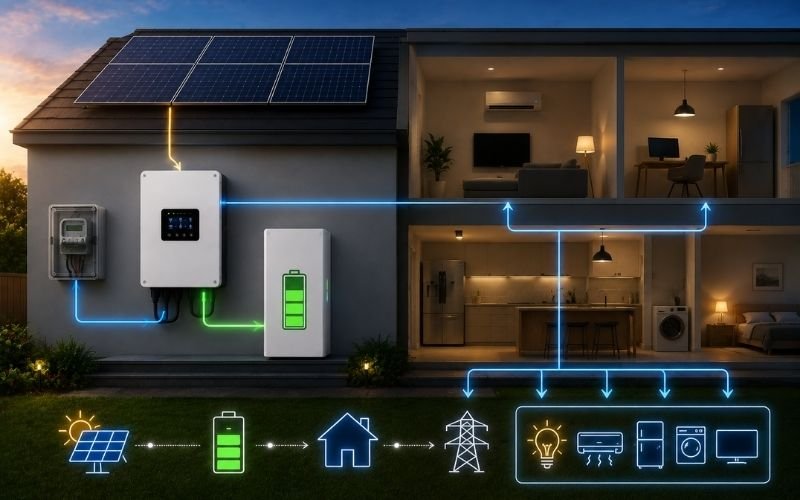
An on-grid solar system is connected to the electricity grid.
During periods of solar generation, the electricity produced by the solar panels can be used by the property.
Depending on the applicable electricity regulations and billing arrangement, excess electricity may be exported to the grid.
On-grid systems are commonly considered by homeowners who want to reduce their electricity purchases from the grid.
Because they generally do not require battery storage, their initial cost can be lower than systems that include batteries.
Do You Need Batteries?
Not every home needs a battery.
If you are considering a standard on-grid solar system, battery storage may not be necessary.
Batteries become more relevant when you require:
- Backup power
- Greater energy independence
- Off-grid operation
- Storage of solar electricity for later use
Battery storage increases the overall system cost, so the decision should be based on your specific energy requirements.
How to Estimate Your Solar Requirement
A basic assessment can begin with your average monthly electricity consumption.
For example, if your electricity bills show relatively consistent monthly consumption, your installer can use that information along with local solar generation conditions to estimate an appropriate system size.
However, this should be treated as an initial estimate rather than a final design.
A professional solar assessment should also consider:
- Site location
- Roof area
- Shading
- Panel orientation
- Electricity consumption
- Existing electrical infrastructure
- Future requirements
Example of Solar System Sizing
Suppose a household reviews its electricity bills and finds that its electricity consumption is consistently high.
Instead of immediately selecting a system based on the number of bedrooms or the size of the house, the homeowner can provide the electricity bills to a solar installer.
The installer can then analyse:
- Average monthly consumption
- Seasonal consumption changes
- Major appliances
- Daytime electricity usage
- Available roof area
- Shading
- Roof orientation
- Future electricity requirements
These factors can then be used to recommend a suitable system configuration.
What Information Should You Give Your Solar Installer?
Before requesting a solar quotation, having the following information ready can make the assessment easier.
Electricity Bills
Provide several recent electricity bills if possible.
Monthly Consumption
Know your approximate monthly electricity consumption in units or kWh.
Major Appliances
Prepare a list of major appliances and their approximate usage.
Roof Information
Provide details about the available roof area and roof type.
Future Requirements
Tell the installer if you plan to add appliances or increase electricity consumption.
Backup Requirements
If you need electricity during grid outages, mention this before the system is designed.
How to Compare Solar Quotations
Once you receive quotations from different solar companies, do not compare only the total price.
Check the complete system specifications.
Compare:
- Solar panel brand and model
- Panel wattage
- Panel efficiency
- Inverter brand and capacity
- Mounting structure
- DC and AC cables
- Protection equipment
- Earthing
- Installation
- Warranty
- Monitoring system
- Maintenance support
- Expected generation
A lower quotation may not necessarily include the same equipment or services as another quotation.
Why System Quality Matters
Solar panels and other system components are intended to operate for many years.
Therefore, the decision should consider long-term performance rather than only the initial installation cost.
Important factors include:
- Equipment quality
- Manufacturer warranties
- Installation quality
- System design
- Electrical protection
- Monitoring
- Maintenance
- After-sales support
A professionally designed and installed system can help you get better value from your solar investment over its operating life.
What Happens During a Solar Site Assessment?
A site assessment allows the solar installer to evaluate whether the property is suitable for the proposed system.
Depending on the project, the assessment may consider:
- Roof dimensions
- Roof condition
- Orientation
- Tilt
- Shading
- Electrical connection
- Inverter location
- Cable routing
- Structural considerations
- Available installation space
This information helps the installer create a more accurate system design and quotation.
Can You Install Solar If Your Roof Has Limited Space?
Yes, but limited roof space can affect the maximum system capacity that can be installed.
Higher-wattage or higher-efficiency panels may help make better use of available space.
However, the final design still needs to account for panel dimensions, spacing, access and other rooftop requirements.
If roof space is limited, discuss this with your solar installer so the available area can be used efficiently.
What If Your Electricity Consumption Is Very Low?
If your electricity consumption is low, installing a very large solar system may not be necessary.
A system should be sized according to your actual energy requirements, available space and financial objectives.
Oversizing can increase the initial investment without necessarily providing proportional benefits.
This is why analysing your electricity bills before selecting the system is important.
What If Your Electricity Consumption Is Increasing?
If your electricity usage is increasing, your solar system should ideally be planned with this in mind.
For example, households may experience higher consumption after installing:
- Additional air conditioners
- Electric vehicles
- Electric water heaters
- New appliances
- Home office equipment
Discussing these future requirements during the initial design stage can help you choose a system that is better aligned with your long-term needs.
Common Mistakes When Choosing Solar Capacity
Choosing the System Based Only on Price
A smaller system may have a lower upfront cost, but it may not meet your electricity requirements.
Ignoring Electricity Bills
Your actual electricity consumption provides valuable information for system sizing.
Ignoring Shading
A roof that looks large enough may not provide sufficient usable space because of shading.
Forgetting Future Electricity Needs
If your electricity consumption is expected to increase, this should be considered before installation.
Choosing the Largest Possible System
A larger system is not automatically the right system.
The capacity should be based on your energy requirements, available roof area and project objectives.
Comparing Only the Number of Panels
Two systems with the same capacity can use different panel wattages and configurations.
Always compare the complete system specifications.
How Can Nexren Energy Help?
Choosing the right solar capacity requires more than simply calculating the number of panels that can fit on your roof.
Nexren Energy can assess your electricity requirements, property conditions and solar potential to help determine a suitable system configuration.
The assessment can consider:
- Electricity consumption
- Roof area
- Solar panel selection
- Inverter requirements
- Shading
- System configuration
- Future energy requirements
- Installation considerations
The goal is to design a solar solution that is aligned with your property's energy requirements rather than simply selecting a standard system size.
Final Thoughts
Choosing the right solar capacity is an important part of planning a rooftop solar installation.
Start by reviewing your electricity bills and understanding your average monthly consumption. Then consider your major appliances, daytime electricity usage, available roof area, shading, roof orientation and future energy requirements.
A solar system should be sized according to your property's actual needs rather than simply choosing the largest or cheapest option available.
Before making a decision, request a detailed quotation that clearly explains the panels, inverter, mounting structure, electrical components, installation, warranties and expected system performance.
With the right system design and professional installation, rooftop solar can become a long-term part of your home's energy strategy.
Thinking about installing solar at your home? Contact Nexren Energy for a solar assessment and get a system designed around your energy requirements.